Posts

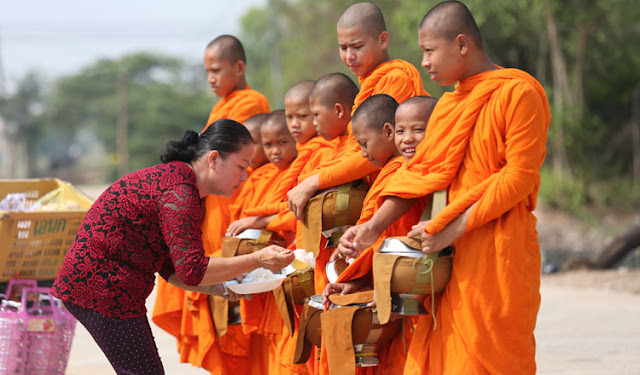
Pursuing Merits in the Most Fruitful Ways
Image
In many Buddhist Southeast Asian countries, merit making is an important fabric of community life. Merit making, or the practice of generosity (Pali: dana ) generally involves rituals such as making donation to help upkeep temples, offering alms to the Sangha or just simply giving one’s time to help in the maintenance of temple facilities. While some do these out of personal altruism, many indulge in these rituals with the hope that their “acts” will bring future blessings, such as a life with less disturbances, better livelihood opportunities or even improved social prospects for members of their family. Without doubt, the dana economy adds a small number into local and country wide GDP, with many days in a year just dedicated to the various rituals. Some however, view these pursuits as a lowly practice, which emphasized on just getting and a "me first (or me always)" focus. Others however, say that true merit making should focus on higher Buddhist practices, such as practi...

Upaya (skill in means) as a method of effective communication

Image
  “ Upaya ” is a pali word which literally means “way”, “means” or “resources”. It is usually associated with kusala , i.e. upayakusala which means “clever in resources” or kosalla i.e. upayakosalla which stands for “cleverness in expedient.” (Ref: “Concise Pali-English Dictionary, A P Buddhadatta Mahathera, U Chandradasa De Silva – Publisher, 1968).   To understand the extant of means used by the Buddha to skillfully communicate the Dharma to his audience of various level of understanding, we cannot move away from the discussion of upaya . In fact, there is direct reference between the Buddha’s perfect communicative ability and the application of skillful means in His prescription of advice.   In the Sangiti Sutta of the Digha Nikaya, it is stated that among the “threes” we have “three kinds of skill: Skill in progress, Skill in regress, and Skill in means” ( tini kosallani: aya kosallam, apaya kosallam, upaya kosallam ; D III 220).   In the Nava Sutta of the Sut...

The Triratna - The world's first global Buddhist icon

Image
  The Triratna (Pali: ti-ratana) is a Buddhist symbol which is thought to have been prevalent during the reign of King Ashoka, the great Maurya ruler (c. 268 – 232 BCE). The symbol represents the Three Jewels of Buddhism - the Buddha, the Dharma, the Sangha. It is shaped by a trident - the 'trisula' - a popular ancient Indian symbol at the time, framed with two golden fish on the left and on the right. The two fishes represents the Yamuna river on one side, and the Ganga on the other. These two rivers, regarded as the most sacred in India, joined as one to form the mighty Ganga. When they were adopted into Buddhism, the fish came to symbolize happiness and spontaneity, due to their freedom to move through water. In a deeper sense, this was freedom from the cycles of birth and death. The central spine between the fish is a parallelogram - which is always four in numbers - that represents the four fold assemby of the monks, nuns, layman and laywomen. Further below the trisula is ...

How to spot a Buddhist cult

Image
  Like any other major religions in the world, Buddhism also has its fair share of cults. Whether the leader is called Guru Rinpoche, Sifu or Bhante, as long as there is tendency to use and abuse the Dharma for personal gain, such as in getting followers to feed on the leader's ego or eccentricity, cultist will always exist. Cults will also thrive as long as there are followers who willingly or have been unwittingly misled. A cult is defined by the Free Dictionary as, (1) A religion or religious sect generally considered to be extremist or false, with its followers often living in an unconventional manner under the guidance of an authoritarian, charismatic leader,  (2)  A usually  nonscientific method or regimen claimed by its originator to have exclusive or exceptional power in curing a particular disease and (3) Obsessive, especially faddish, devotion to or veneration for a person, principle, or thing. Here are some key signs where cultists can be spotted. The lead...

Welcome to my musings, views and all things Buddhism

Image
  After years of deliberation, I have finally decided to reactivate my Buddhist blog. Originally called "Lotus Seeds", it was meant to share Dhamma teachings and talks which I have given at temples. I have lost counts on the number of Dhamma sharings and talks that I have given over 30 years, but it's probably in the hundreds. In this rebirth, the blog is now renamed "Bodhi Mandala" and instead of just posting my talks and sharings, I will (when time permits) express my views and opinions on areas of concern such as dogmatism, sectarianism, life as a Buddhist in Malaysia, Dhamma outreach and technology and state of the Buddhist situation primarily in Malaysia. The Buddhist Channel Over the years also, due to my work in the Buddhist Channel ( BC - https://buddhistchannel.tv/ ), I have been exposed to news makers and situations which directly or indirectly have impact on Buddhist development here and elsewhere. The BC has enabled me to network with similar news...